
Quick summary
- Many men overpack for trips "just in case," then carry the extra weight the whole way and still forget the one tool they need.
- Most "just in case" items are small tools: a knife, a can opener, a screwdriver, a saw, a fire starter, a whistle.
- One folding multitool can replace several of those single-use items and lighten your bag.
- Flying? In the U.S., knives and multitools with blades are not allowed in carry-on bags. Pack them in checked luggage, sheathed or wrapped.
- Pack by job, not by gadget: ask what you actually need to do on the trip, then bring the fewest items that cover it.
You are halfway up the trail and your shoulders are burning. You stop, open your pack and look inside: a pocketknife, a separate folding saw, a mini screwdriver set, a can opener, two lighters, a whistle on a lanyard and a few things you cannot even remember packing. Then someone asks if you have anything to cut moleskin with, and the knife is buried at the very bottom.
Overpacking is one of the most common travel mistakes, and it is not just a hiking problem. Weekend trips, fishing trips, cabin stays and vacations all suffer from it. This guide looks at why we overpack, what it really costs and how one compact multitool helps you travel lighter without feeling unprepared.
Why men overpack for trips

In short: Overpacking usually comes from wanting to be ready for anything. The result is a heavy bag full of single-use items.
Most of us overpack for a good reason: we do not want to be the guy who is unprepared. Maybe you once needed a screwdriver on vacation and did not have one. Maybe a camping trip went sideways because nobody packed a knife. So now you bring everything.
The trouble is that "everything" adds up quickly. Every tool that does only one job takes up its own space and adds its own weight. And the more separate items you carry, the harder it is to find the one you need when you need it.
The goal is not to pack less for the sake of it. It is to stay prepared while carrying fewer things. That is exactly where a multi-function tool earns its place.
What the "just in case" pile really costs you

In short: Extra items cost you comfort, space, time and sometimes money in baggage fees. Fewer, smarter items make every part of the trip easier.
Look at the hidden costs of a heavy, cluttered bag:
- Comfort. On a hike, every extra item ends up on your shoulders and hips for hours. Even small things add up when you carry them all day.
- Space. Single-use tools crowd out things you actually want, like a warm layer, extra water or snacks.
- Time. Digging through pouches and pockets to find the right gadget wastes time at camp, on the trail and at the car.
- Money. When you fly, an overstuffed bag can push you into a bigger bag or an extra checked bag.
- Forgetting. The more items on your list, the easier it is to leave one behind. One tool is much easier to remember than six.
Cutting the pile does not mean going without. It means choosing items that each do several jobs well.
What one 13-in-1 tool can replace

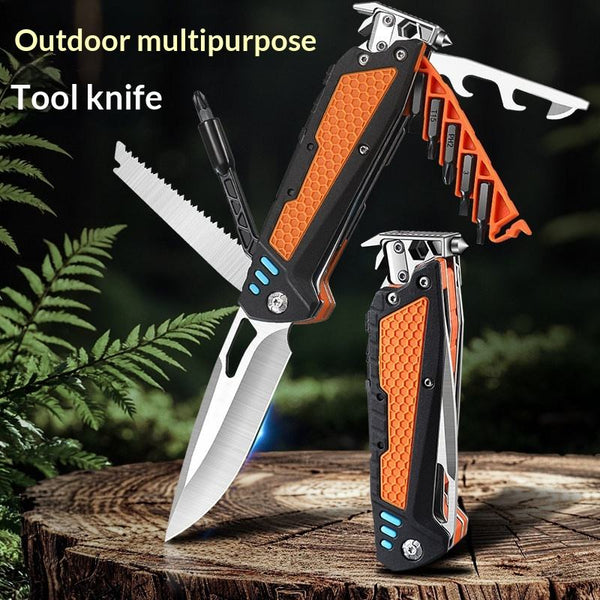
In short: A folding multitool with a knife, saw, bits, openers, glass breaker, fire starter and whistle covers the small tools most travelers carry separately.
Here is a simple way to see how much a single multitool can consolidate:
| What you would usually pack | Covered by |
|---|---|
| Pocketknife or small scissors | Folding knife and rope cutter |
| Small folding saw | Steel saw |
| Travel screwdriver set | Interchangeable screwdriver bits |
| Hex keys for bikes, racks or furniture | Hex wrench |
| Can opener and bottle opener | Built-in can and bottle opener |
| Spare fire starter | Magnesium fire starter |
| Emergency whistle | Built-in whistle |
| Car escape tool | Glass breaker |
The bits sit in hidden magnetic storage inside the handle, and the whole tool fits in a nylon pouch with a belt loop. That means one small item on your belt instead of a bag of loose gadgets rattling around in your pack.
On the trail: carrying less and doing more

In short: On a day hike or overnight, a multitool on your belt handles cutting, small repairs and emergencies without adding a pile of extra gear.
On the trail, small jobs come up all the time. A pack strap needs trimming. Moleskin or tape needs cutting for a hot spot on your heel. A buckle screw on a trekking pole works loose. A fallen branch is blocking the path to your campsite.
A multitool on your belt handles all of these without stopping to unpack. The knife and rope cutter take care of cutting jobs, the screwdriver bits fix small gear, and the saw clears small branches or cuts firewood to size where fires are allowed.
It also covers two safety basics. The whistle lets you signal your group or call for help if you get separated, and the fire starter is a backup if your lighter fails in cold or wet weather. Keep both on your body rather than deep in your pack, because in an emergency you may not have time or light to dig for them.
Fishing trips, cabins and lake weekends

In short: Lake and cabin trips are full of small jobs: cutting line, opening cans and bottles, tightening screws. One tool in your tackle bag or pocket handles them all.
Fishing trips have their own list of small annoyances. You need to cut line and leader. A screw on your tackle box latch or rod holder works loose. Somebody packed canned food but no can opener. Somebody brought bottled drinks but no opener. The cabin's folding table wobbles all weekend.
Instead of packing a separate knife, opener and screwdriver into your tackle bag, keep one multitool in its pouch. It cuts line and cord, opens food and drinks and tightens small screws on gear and furniture. After a day on the water, rinse the tool in fresh water, dry it fully and let it air out before folding it. Water and fish slime left in the hinges are the fastest way to dull a blade and stiffen a tool.

13-in-1 Folding Multitool Knife
Knife, saw, screwdriver bits, hex wrench, openers, glass breaker, fire starter and whistle in one tool with a belt pouch. Pack one item instead of eight.
See the multitoolFlying? Read this before you pack your multitool

In short: In the U.S., TSA does not allow knives, including multitools with blades, in carry-on bags. Pack your multitool in checked luggage, sheathed or securely wrapped.
This is the one rule every traveler with a multitool needs to know. Under TSA rules, knives are not allowed in carry-on bags, and that includes multitools with a blade. If a tool with a blade is found at the security checkpoint, you will usually have to give it up, mail it home or take it back to your car.
Here is how to avoid losing your tool at the airport:
- Pack it in your checked bag. TSA asks that sharp objects in checked luggage be sheathed or securely wrapped to protect baggage handlers and inspectors. The nylon pouch helps with this.
- Check the extras. Rules for items like fire starters can differ from rules for blades. Check the TSA "What Can I Bring?" page and your airline's rules before you fly.
- Traveling internationally? Rules for carrying and owning knives vary a lot between countries. Look up the rules for your destination before you go.
- Carry-on only trip? If you are not checking a bag, leave the multitool at home or plan to buy basic supplies at your destination.
Look after the one tool you rely on

In short: When one tool replaces several, it needs a little care. Clean it, dry it, check the bits and keep it in the same place.
Packing light works only if the one tool you bring is ready to go. Because you are relying on a single item instead of a bag of backups, a few minutes of care after each trip pays off:
- Clean and dry it. Wipe off dirt, sap and food. If it got wet, open every function and let it dry fully before folding it back up.
- Count the bits. Check that the screwdriver bits are all back in the magnetic storage. A missing bit is easy to replace at home and impossible to replace on the trail.
- Check the extras. Make sure the fire starter and whistle are still attached and the pouch snap still closes.
- Store it in one place. Put it back in the same pocket of your travel bag or in your car console, so it is always ready for the next trip.
A tool that is clean, complete and always in the same spot is a tool you never have to think twice about packing.
A simple "pack by job" checklist

In short: Instead of packing a gadget for every "what if," list the jobs you might need to do and bring the fewest items that cover them.
The easiest way to stop overpacking is to change how you plan. Instead of asking "what might I need?", ask "what jobs might I need to do?" Then cover those jobs with as few items as possible:
- Cutting: folding knife and rope cutter.
- Small repairs: screwdriver bits and hex wrench, plus a few zip ties and a small roll of tape.
- Food and drink: can opener and bottle opener.
- Fire: one lighter plus the magnesium fire starter as a backup.
- Safety: whistle on your belt, a small first-aid kit and a headlamp.
- Driving to the trailhead: glass breaker within reach in the car.
Lay everything out on the bed before you pack. Anything that does a job already covered by something else can probably stay home. You will be surprised how much lighter your bag gets, and how much easier it is to find what you need.
Traveling light is not about going without. It is about carrying smarter. One good multitool on your belt replaces a bag of single-use gadgets and goes with you on every trip, from the trail to the lake to the long drive home. For more on handling small jobs away from home, read our guide to camping and road trip repairs.