
Quick summary
- The problem is rarely having too few tools. It is that the right tool is never where you are when something breaks.
- Most everyday fixes fall into two groups: "big" jobs (bolts, nails, wire, cutting) and "small" jobs (electronics, glasses, gadgets).
- A compact two-tool kit covers both: a full-size multitool for big jobs and a precision bit set for small ones.
- Keep one kit where problems actually happen: kitchen drawer, truck, or camping bin.
- Organization and a few safety habits matter as much as the tools themselves.
The cabinet door is hanging crooked again. You know there is a screwdriver somewhere: maybe in the garage, maybe in the junk drawer, maybe in the truck. Ten minutes later you are still looking, and the two-minute fix has turned into a project. Or you are at the campsite, the trailer hitch needs adjusting, and the wrench you need is sitting on a workbench a hundred miles away.
Most people do not have a tool shortage. They have a tool location problem. This guide shows you how to build a small, organized repair kit that handles most everyday jobs at home, in the truck and on the road. It takes up less space than a shoebox.
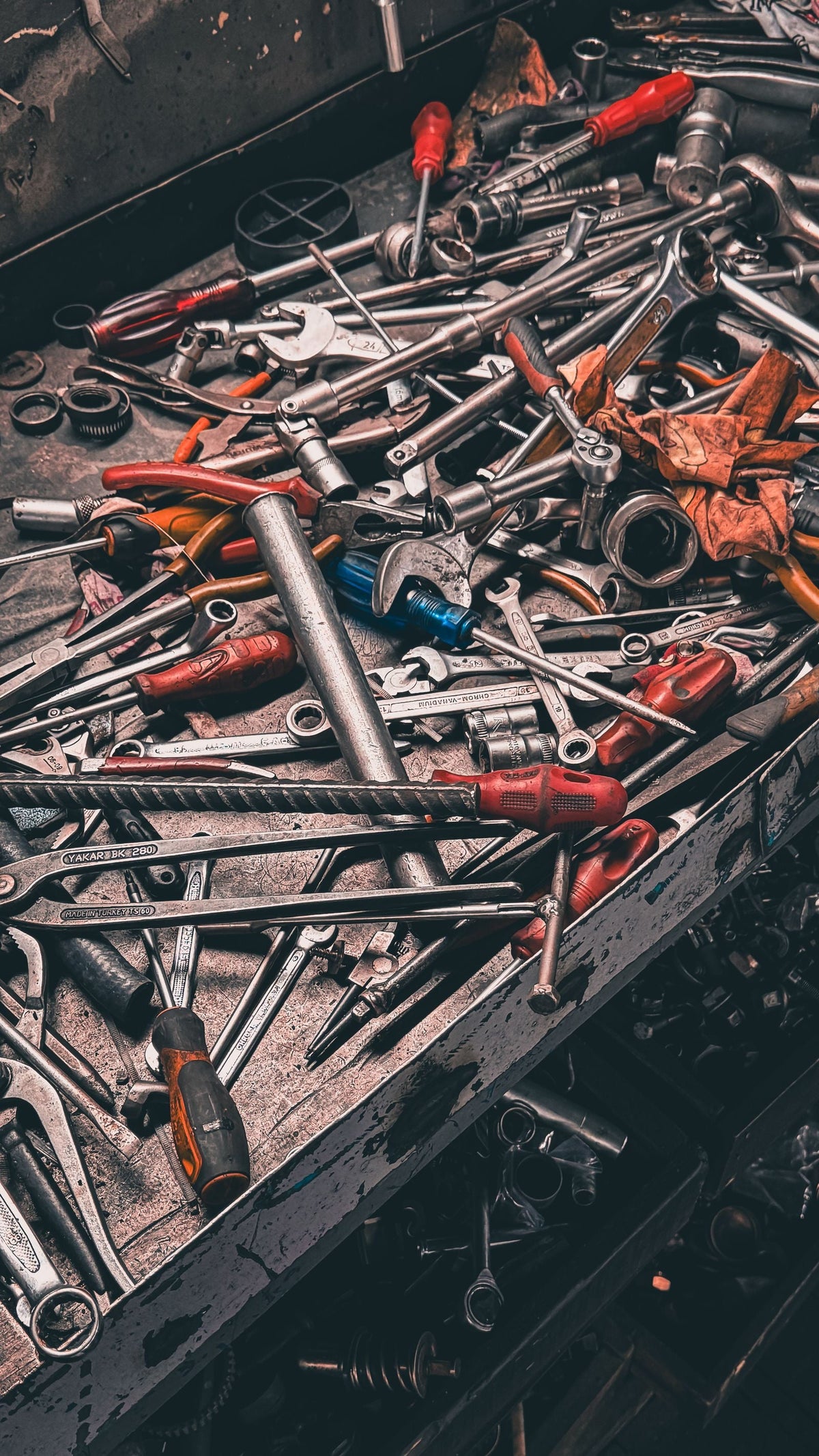
Why the big toolbox fails when you need it

In short: Big toolboxes get messy, stay in one place and take time to search. Small fixes get put off because getting the tools out is more work than the fix itself.
A full toolbox is great for big projects. For everyday fixes, it has three problems:
- It is in the wrong place. The toolbox lives in the garage. The loose hinge is upstairs, the wobbly mirror is in the truck, the broken tent pole is at the campsite.
- It is a mess. Over time, everything ends up in one pile. Finding the 10mm wrench or the small Phillips means digging.
- It is heavy. Nobody carries a 30-pound box up the stairs to tighten one screw, so the screw stays loose for another month.
The fix is not to buy more tools. It is to keep a small, organized kit exactly where you need it.
Which jobs actually come up

In short: Look at what you actually fix in a year. It is mostly loose screws and bolts, small electronics, hanging things, cutting things, and quick fixes on gear.
Before you build a kit, think about the last year. For most households, the list looks something like this:
| Job type | Examples | Tool you need |
|---|---|---|
| Tighten or loosen | Cabinet hinges, furniture legs, bike seat, trailer hitch | Screwdrivers, adjustable wrench |
| Hang or remove | Pictures, hooks, shelves, old nails | Hammer, nail puller |
| Cut and strip | Zip ties, rope, packaging, wire | Knife, wire cutter, saw |
| Grip and bend | Stuck nuts, small parts, wire | Pliers, needle-nose pliers |
| Small electronics | Controllers, laptops, remotes, glasses | Precision bits (Phillips, Torx, Pentalobe, Y-type and more) |
Notice the split: the first four rows are "big" jobs that need leverage and strength. The last row is "small" jobs that need precision. One tool rarely does both well. That is why a two-tool kit works.
Tool one: a full-size multitool for the big jobs

In short: One rugged multitool with a wrench, hammer, pliers, cutters, screwdrivers, knife and saw replaces a drawer full of single tools for everyday jobs.
For the "big" jobs, you want a multitool with real working tools, not just a knife and a bottle opener. The 18-in-1 Multifunctional Wrench Hammer puts the essentials into one compact body:
- Adjustable wrench for nuts and bolts on furniture, bikes, hitches and fixtures
- Hammer and nail puller for hanging pictures, tapping things into place and pulling old nails
- Pliers and needle-nose pliers for gripping, bending and reaching into tight spots
- Wire cutter for wire, zip ties and light cutting
- Screwdrivers (PH1, PH2, SL4.5) for the most common household screws
- Knife and saw for packaging, rope, branches and quick cuts
It comes with a carry pouch, so it can ride on your belt, sit in a glovebox or live in a kitchen drawer without scratching everything around it.

18-in-1 Multifunctional Wrench Hammer
Wrench, hammer, pliers, wire cutter, screwdrivers, knife and saw in one compact tool with a pouch.
See the multitoolTool two: a precision bit set for the small jobs

In short: Electronics, glasses and gadgets use tiny, unusual screws. A precision kit with many bit types and a magnetic holder handles them without stripping anything.
Multitools are made for strength, not for the tiny screws in a game controller or a pair of glasses. For those, you need a precision set, and a good one is the difference between a quick fix and a stripped screw.
The 132-in-1 Industrial Precision Tactical Kit covers the small side of your kit:
- 132 chrome-vanadium steel bits: Phillips, Torx, flathead, Pentalobe, Triangle, Y-type, U-type and other specialty shapes
- Quick-change magnetic bit holder that keeps tiny screws from dropping
- Organized storage case where every bit has its own slot
Use it for laptops, consoles, controllers, phones, eyeglasses, watches, remotes, small appliances and EDC gear.
Where to keep your kit: home, truck and camp

In short: Put the kit where problems happen. One in the house is a must. A second in the truck or camping bin saves a lot of trips.
A kit only helps if it is close by. Think about where things break in your life:
- Home: a kitchen or hallway drawer beats the garage. Loose hinges, furniture, kids' toys, remotes and glasses all get fixed on the spot.
- Truck or car: a multitool in the glovebox or console handles loose trim, battery terminals, hitch hardware and roadside surprises. The precision case fits under a seat.
- Camping and outdoors: tent poles, stove fittings, trailer hardware, flashlights and optics. Pack the kit in your gear bin so it goes on every trip automatically.
- Desk or workshop: if you tinker with electronics or build PCs, a precision set at the desk saves you walking back and forth.
If you only start with one location, pick the one where you have said "I need a screwdriver" most often this year.
Keep it organized so it stays useful

In short: Every tool has a home, everything goes back after use, and a quick check every few months keeps the kit ready.
The reason a junk drawer fails is not the tools. It is the mess. A small kit stays useful if you follow three simple rules:
- Every tool has a home. The multitool goes back in its pouch, and each bit goes back in its slot. Cases with fixed slots make this automatic: an empty slot shows you exactly what is missing.
- Put it back right away. The moment the job is done, the tool goes back. "Later" is how the kit ends up scattered around the house.
- Do a quick check. Every few months, open the kit, wipe off dust or moisture, and make sure nothing has wandered off.
Add a few small extras if you like: a roll of electrical tape, some zip ties and a small flashlight. Keep it lean though. Once a kit gets too big, it turns back into a toolbox nobody wants to carry.
Three everyday fixes your kit can handle today

In short: A sagging cabinet door, a wobbly table and a loose pair of glasses are all 5-minute jobs once the right tools are close by.
To see how the two-tool kit works in real life, here are three jobs that come up in almost every home:
1. The sagging cabinet door
Open the door and look at the hinges. Most kitchen hinges have two or three Phillips screws: one or two hold the hinge to the cabinet, and one adjusts the door left and right. Tighten any loose mounting screws with the multitool's PH2 screwdriver, then turn the adjustment screw a quarter turn at a time until the door lines up with its neighbor. If a screw just spins, the hole is worn. A wooden toothpick and a drop of wood glue in the hole gives the screw something to bite into again.
2. The wobbly table or chair
Flip it over and check every bolt and screw where the legs meet the frame. Use the adjustable wrench for bolts and the screwdrivers for screws. Tighten them in a cross pattern, a little at a time, so the frame pulls together evenly instead of twisting.
3. Glasses that slide down your nose
Loose hinge screws are the usual cause. Pick the smallest flathead or Phillips bit from the precision kit that fits the hinge screw snugly, hold the frame on a soft cloth, and turn gently until the arm moves smoothly but stays where you put it. Do not overtighten. Small eyewear screws strip easily.
None of these jobs needs special skills, just the right tool within reach.
Safety basics for everyday repairs

In short: Turn off the power, cut away from your body, use the right tool for the job, and know when to call a professional.
Small repairs are low-risk, but a few habits keep them that way:
- Power off. Unplug electronics and turn off breakers before touching anything wired to your home's electrical system.
- Cut away from yourself. Always move the knife or saw away from your hands and body, and close blades and lock tools after use.
- Use the right tool. Do not use a screwdriver as a pry bar or a wrench as a hammer. That is how tools break and hands get hurt.
- Protect your eyes. Wear safety glasses for hammering, cutting wire or anything that could send a chip flying.
- Keep sharp tools away from kids. Store the kit somewhere they cannot reach.
- Know your limits. Gas lines, major electrical work and anything structural are jobs for a licensed professional.
Your compact repair-kit checklist

In short: One multitool for the big jobs, one precision set for the small jobs, kept where problems happen and put back after every use.
- A full-size multitool with wrench, hammer, pliers, cutters, screwdrivers, knife and saw
- A precision bit set with a magnetic holder and an organized case
- One kit in the house, and a second in the truck or camping gear if you can
- A few extras: electrical tape, zip ties, a small flashlight
- A simple rule: every tool goes back in its place right after the job
With two well-chosen tools in the right places, the loose hinge gets fixed today instead of next month, the campsite repair takes five minutes instead of ruining the trip, and you stop buying the same screwdriver for the third time because you could not find the first two.